

- Smart sensors catch defects on the automotive assembly line before they escalate.
- Industry 4.0 in automotive manufacturing replaces reactive fixes with predictive precision.
- Digital twins simulate every assembly stage before production even begins.
- Auto components manufacturers in Coimbatore are driving India’s connected manufacturing shift.
- Industry 4.0 in automotive manufacturing compresses lead times while maintaining quality.
From Manual to Machine Intelligence: What Changed on the Floor
As we have observed, automotive production lines have continuously evolved from paper-based checklists to fully digital dashboards that monitor in real time. From regular planned shutdowns to sensor-initiated messages that warn the staff. The change is not just a cosmetic one. Industry 4.0 in automobile manufacturing, as well as other industries that use similar technologies, completely changes how choices are made (i.e., through data analysis), where things are done (in different work cells rather than one big one), and what gets detected.
What do the current systems use to detect the products that should be on hold? They identify the vibration pattern of the IIoT device not by a supervisor going around and visually inspecting the process line.
| Then (Pre-Industry 4.0) |
Now (Industry 4.0) |
| Manual inspection at end-of-line | Real-time sensor-based defect detection |
| Scheduled preventive maintenance | Predictive maintenance via machine data |
| Paper-based production logs | Live ERP-integrated dashboards |
| Reactive quality holds | Automated upstream defect triggers |
| Human-dependent tolerance checks | Vision systems with micron-level accuracy |
The distinction goes further than just the reaction time. There will be fewer issues; for example, one problem will generate other ones. Then, the issue will be resolved, while there will still be less impact that can be measured through costs.
Where the Automotive Assembly Line Stands Now
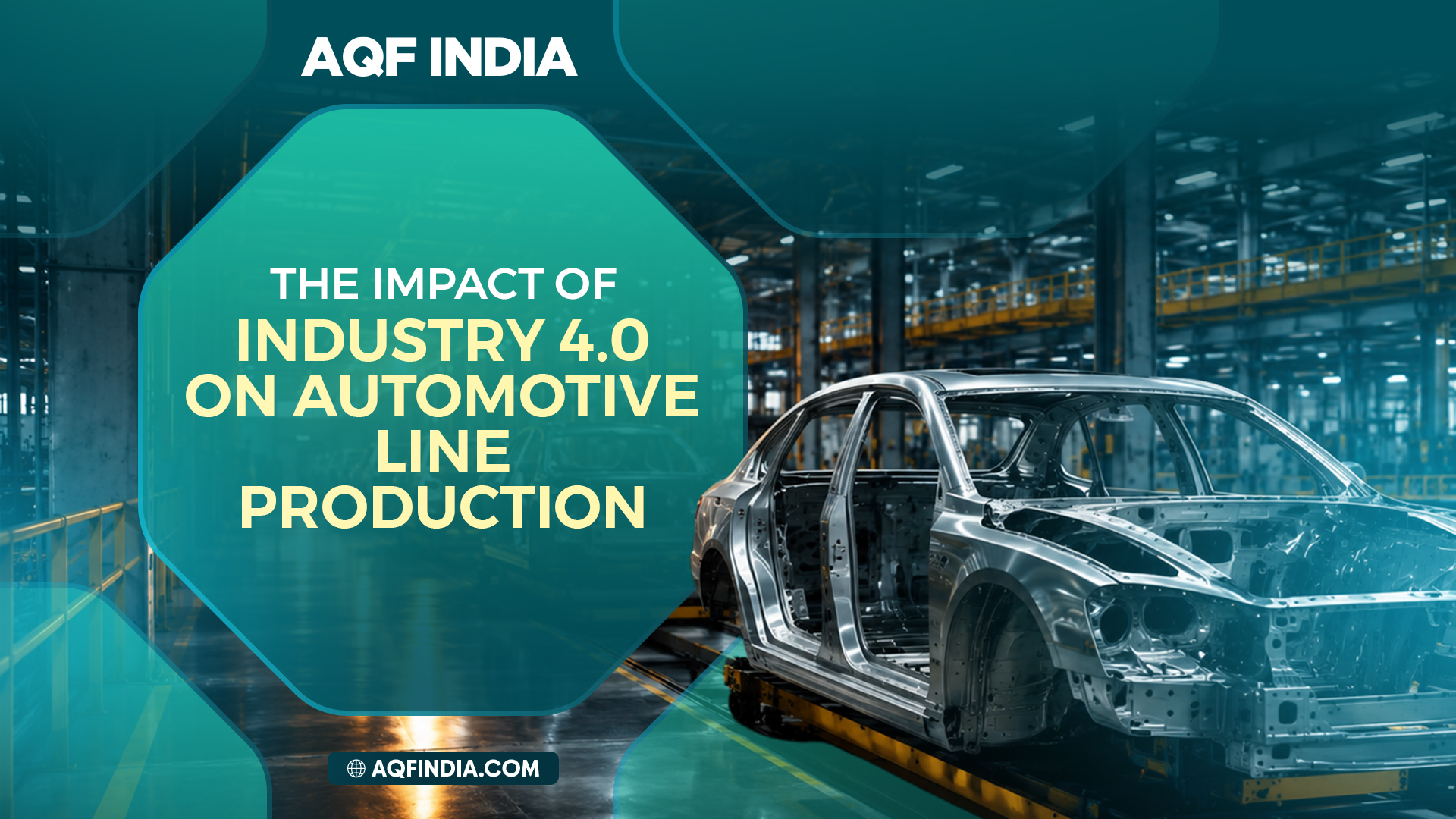
If today’s automotive assembly line is indeed faster, it is not just because of speed but also because of the accuracy and precision of the processes. As the robotic arms can make adjustments to the product on the go, the systems for imaging will spot the slightest imperfections in the welding, which is done at a very low tolerable level. Every single workstation generates a great deal of data, and that data stream comes back into the workflow.
In essence, the consequence, of course, will be a drastic decrease in the number of the reworking instances, a much more strict adherence to product specifications, or at least one that is very close to them without being overreaching, and, in addition, a production schedule that will grow in parallel, keeping the pace intact but, most importantly, not causing any disruption to the work.
Core Technologies Driving the Shift
Not every Industry 4.0 tool carries equal weight on a production floor. Here’s what’s actually moving the needle:
| Technology | Application on the Line | Impact |
|---|---|---|
| IIoT Sensors | Real-time machine health monitoring | Reduces unplanned downtime by up to 30% |
| Digital Twins | Virtual simulation of assembly stages | Cuts prototype-to-production time significantly |
| AI-Based Vision Systems | Inline dimensional and surface inspection | Near-zero escape rate for surface defects |
| CNC-ERP Integration | Automated job routing and traceability | Eliminates manual data entry errors |
| Collaborative Robots (Cobots) | Assist machinists in repetitive precision tasks | Improves throughput without sacrificing accuracy |
These aren’t pilot projects anymore. They’re running on production floors, including those of auto components manufacturers in Coimbatore who supply directly to Tier-1 and OEM customers.
Why Coimbatore Is at the Center of This Shift
Auto components manufacturers in Coimbatore are no longer outsiders to this change; they are part of it. The city’s whole culture of precision manufacturing has been gradually adopting the Industry 4.0 instruments: ERP systems integrated with CNC machines, quality alert systems that get activated automatically, tracing materials and other raw supplies from raw input until they are shipped out.
According to AQF India, these are simply new forms of precision manufacturing that don’t disrupt but sharpen the capabilities we already possess so well.
The Metrics That Actually Matter
Industry 4.0 in automotive manufacturing doesn’t just promise efficiency; it delivers measurable outcomes:
| KPI | Pre-4.0 Benchmark | Post-4.0 Performance |
|---|---|---|
| First-Pass Yield | 85–88% | 95%+ |
| Mean Time Between Failures | Unpredictable | Monitored and Managed |
| Defect Escape Rate | 2–4% | Below 0.5% |
| Production Lead Time | High Variability | Consistently Compressed |
| Rework Cost per Batch | Significant | Reduced by Early Detection |
The automotive assembly line that runs on real-time data outperforms the one that runs on experience alone, every single time.
What Comes Next for Auto Components Manufacturers in Coimbatore
One must clearly understand that the next big thing is not going to be AI taking over the work of machinists or replacing them. Rather, AI will be used to help human machinists work smarter and be more efficient by enhancing the work they do. The trend is towards auto component manufacturers in Coimbatore developing the so-called closed-loop quality systems, where the inspection outcome is relayed directly back to the machining process parameters.
AQF India is already inside this shift, building components that don’t just meet specs but carry data trails that prove it.
Final Thought
You can think of Industry 4.0 as being a blueprint for the future, but for the automobile manufacturing industry, it is not a roadmap yet; rather, it is a reality that OEMs are already living today.
If you plan to procure components to be used in a smart automotive assembly line setup, then your supplier of these should meet at least your standards of precision and connectivity.
Get AQF India onboard – where each mechanical part is manufactured to a standard level of connectivity that the Industry 4.0 automotive assembly line expects.
FAQs
- How does Industry 4.0 improve quality on the automotive assembly line?
- It moves quality control upstream. Sensors, vision systems, and live data catch deviations at the source, not at the end of the line where rework costs are highest.
- Are auto components manufacturers in Coimbatore adopting Industry 4.0 tools?
- Yes, and rapidly Coimbatore’s precision manufacturing base is integrating IIoT, CNC-ERP connectivity, and automated inspection into active production environments, not just pilot setups.
- What’s the biggest operational shift Industry 4.0 brings to automotive manufacturing?
- The move from scheduled maintenance to predictive maintenance. Machines flag issues before failure, reducing downtime, protecting output, and keeping delivery timelines intact.