

- Tolerances are unforgiving; microns determine fit, function, and safety.
- Errors multiply quickly. One flawed component can shut down the whole line.
- Compliance is non-negotiable; OEM standards require verified dimensional accuracy.
- Supply chain trust is earned; consistent quality is what keeps long-term contracts alive.
Precision Isn’t a Feature. It’s the Foundation.
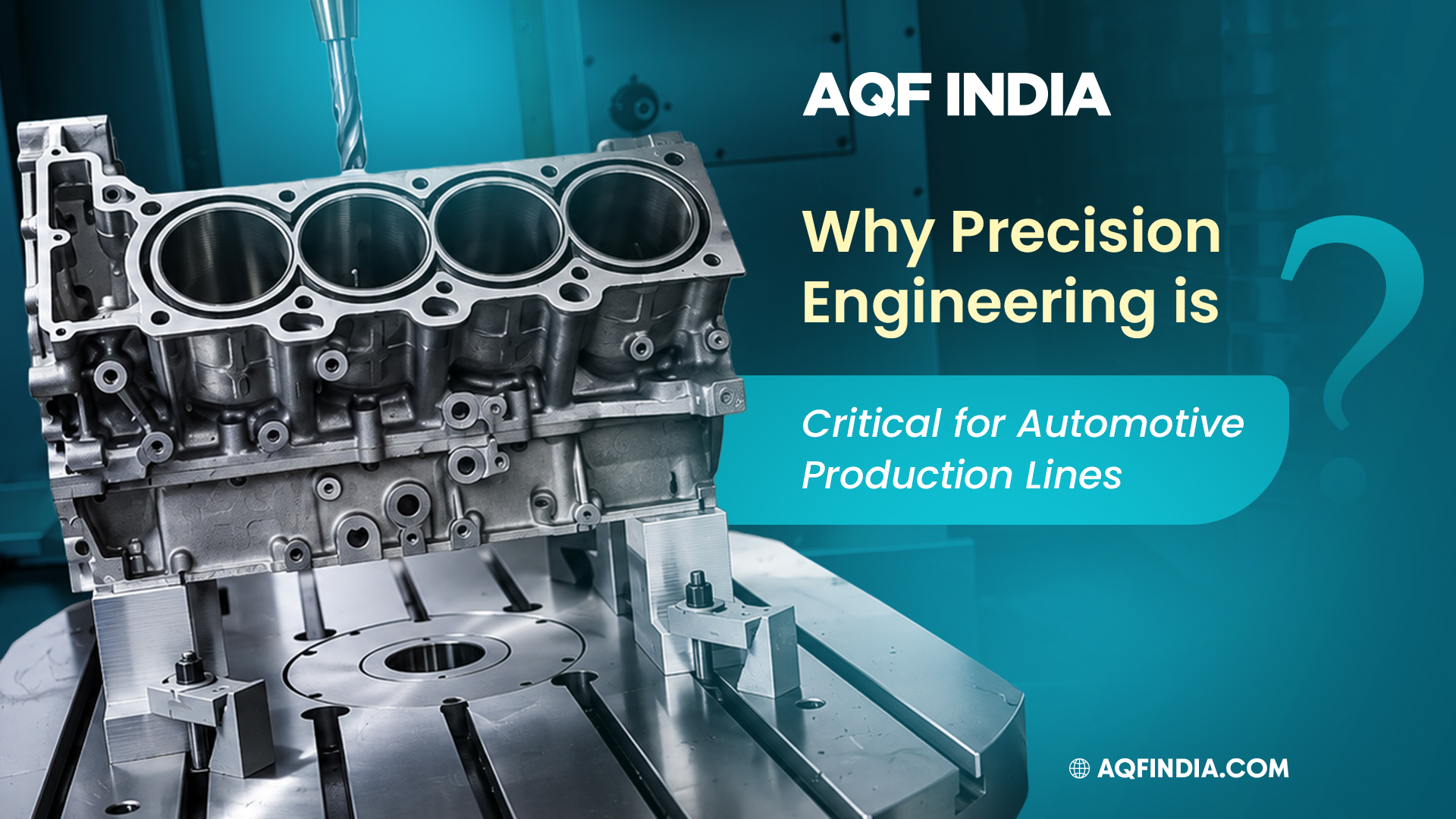
Every vehicle rolling off an assembly line is only as reliable as its weakest component. Engine housings, transmission parts, brake assemblies, suspension brackets – each one must meet exact dimensional specs, batch after batch, with zero deviation.
That’s the challenge automotive production lines face daily. And it’s exactly why automotive precision engineering isn’t just a manufacturing preference; it’s a production mandate.
We’ve seen what happens when it’s compromised. Rework costs spike. Line stoppages follow. OEM relationships fracture. None of that is recoverable quickly.
Where Precision Breaks Down and What It Costs
| Failure Point | Root Cause | Production Impact |
| Dimensional variance in machined parts | Inconsistent tooling or setup | Assembly rejection, rework loops |
| Surface finish non-conformance | Incorrect feed rate or tooling wear | Friction, noise, premature wear |
| Bore/hole positional error | Fixturing instability | Misalignment in final assembly |
| Material inconsistency | Poor raw material qualification | Structural failure under load |
| Tolerance stack-up | Poor design-to-manufacture alignment | System-level malfunction |
These aren’t hypothetical scenarios. They’re the exact failure modes that derail production timelines and inflate warranty claims.
What “Precision” Really Demands on a Production Line
Automotive production isn’t forgiving of guesswork. Here’s what it actually takes:
| What It Takes | Why It Matters |
| Tight Tolerance Machining | Components machined to ±0.005 mm or tighter; anything looser creates variability that multiplies through sub-assemblies. |
| Process Repeatability | One good part isn’t enough; consistent output across hundreds or thousands of identical components, with zero drift. |
| In-Process Quality Control | End-of-line inspection is too late; quality checks must be embedded at every machining stage, not just final output. |
| Material Traceability | Every automotive precision component needs clear material certification and batch traceability; no shortcuts. |
Why Automotive OEMs Are Raising the Bar, Not Lowering It
Automotive production lines are developing faster than most suppliers admit. EV platforms, ADAS systems, and hybrid drivetrains don’t tolerate the tolerances that sufficed a decade ago.
Why Automotive OEMs Are Raising the Bar, Not Lowering It
Automotive production lines are developing faster than most suppliers admit. EV platforms, ADAS systems, hybrid drivetrains; these don’t tolerate the tolerances that sufficed a decade ago.
| Application | Old Tolerance Standard | Current Requirement |
| Engine Components | ±0.02 mm | ±0.005 mm |
| EV Motor Housings | N/A | ±0.003 mm |
| Brake Caliper Bores | ±0.01 mm | ±0.005 mm |
| Transmission Gears | ±0.015 mm | ±0.008 mm |
This table highlights a bigger picture as vehicles become more intelligent and efficient. A higher level of precision is required for the individual components that comprise them. The automotive precision engineering industry needs to match its advancements; otherwise, it is the production process that has to pay the price.
The Supplier Side: What Automotive OEMs Actually Look For?
From conversations across the industry, here’s what OEM procurement teams consistently demand from a precision component manufacturer.
- Proven CNC machining capability with documented process controls.
- PPAP (Production Part Approval Process) readiness.
- ISO 9001:2015 certification at minimum; IATF 16949 preferred for automotive.
- On-time delivery rates above 95%.
- CMM-backed dimensional inspection reports per batch.
At AQF India, these aren’t aspirational targets; they’re built into the production process from day one.
Precision Under Pressure: The Line Production Reality
Automotive production lines run on rhythm. Every station, every sub-assembly, every fastened joint has a timed window. Inconsistent parts from a supplier break the entire assembly rhythm.
The downstream effects are severe:
- Assembly teams stop and sort, wasting labour hours.
- Line supervisors escalate to procurement, creating supplier friction.
- Quality holds freeze inventory, delaying vehicle dispatch.
This is why automotive precision components must arrive right the first time, every time. Not mostly. Every time.
We understand that pressure intimately. Our machining processes are built to eliminate variability, not just manage it.
The AQF India Approach: Precision as a System, Not a Step
At AQF India, precision isn’t a quality department function; it runs across the entire value chain. From design-for-manufacturability review to machining parameter control, to final CMM inspection and documentation, every stage is accountable to the same standard.
We serve automotive OEMs who need automotive precision components delivered to spec, on schedule, with full traceability. That combination of process discipline and technical depth is what defines serious automotive supply capability.
Final Thought
Automotive production lines don’t have room for imprecision. Fixing mistakes, dealing with downtime, and losing customer trust costs far more than simply making the part correctly the first time.
That’s the case for automotive precision engineering, made in the simplest terms possible.
If your production line demands components that perform without compromise, connect with AQF India. Let’s talk about what precise, consistent, and traceable supply looks like for your application.
FAQs
- What tolerances are standard for automotive precision components?
- Critical automotive parts typically require tolerances of ±0.005 mm or tighter, especially for engine, brake, and EV drivetrain applications.
- How does precision engineering reduce production line downtime?
- High-quality, precise parts prevent rework and assembly delays, keeping production on schedule.
- What certifications should a precision component manufacturer hold for automotive supply?
- ISO 9001:2015 is the baseline. IATF 16949 certification is the preferred standard for direct automotive OEM supply.