

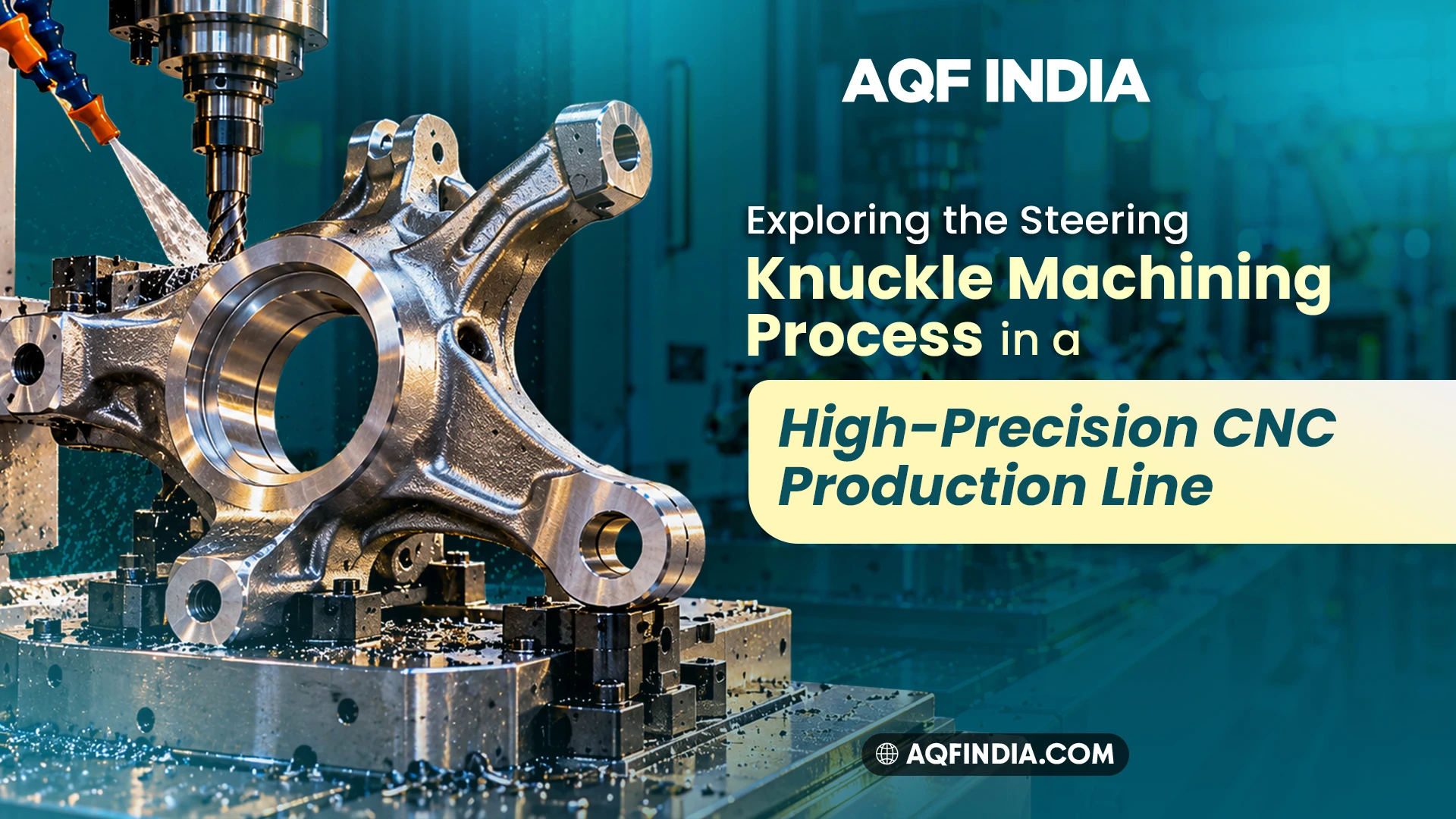
- Steering knuckle machining process turns a rough casting into the part that holds the wheel, brake, and suspension together.
- Steering knuckle function in one line: carry the bearing, hold the caliper, link the suspension.
- Front, rear, heavy-duty: the types of steering knuckle change the plan, never the accuracy demand.
- Datum setup, bore, caliper face, inspection. Miss one step and the error rides along.
- Automotive steering knuckle components are safety parts. “Close enough” doesn’t cut it.
Steering Knuckle Function: The Part Behind the Wheel
Remove a front end-of-car wheel, and you’ll find an oddly shaped block of metal attached to the suspension. The steering knuckle is that. It doesn’t have a name until it causes trouble, and no one takes pictures of it.
This is what you will find on it. It contains the wheel bearing. It is fastened to the brake caliper. It connects to the control arms and the tie rod that keeps the wheel in line with the others and steers it. All bumps and all hard stops are pushed through that one casting.
If the bearing bore is slightly out-of-trueness, then the wheel is slightly out-of-trueness. If the caliper face is not flat, then the brakes judder. A motorist reports a vibration at 80km per hour; a service centre replaces the tyres and discs, and the actual reason is the bore was cut incorrectly months before.
Types of Steering Knuckle You’ll Come Across
Not all knuckles look alike, and once they land on a machine, the differences matter.
Front knuckles are the busiest. They carry the wheel bearing, take the steering input, and have ball joint tapers plus mounting points for the caliper and tie rod. Rear knuckles are plainer, usually built around a trailing arm or axle mount with nothing to do with steering. Then you have the heavy-duty ones for trucks and off-highway vehicles. They’re bigger, and often carry reinforced kingpin bosses.
The job also changes as well. The standard choice for volume production is ductile iron, which’s strong and cuts evenly. Heavier-duty forged steel. Forged aluminium is used when weight is a factor. The design on the drawing determines the cutting process, as each requires its own cutting speeds, tooling, and clamping requirements.
The Steering Knuckle Machining Process, Step by Step
Details change from one design to the next, but a high-precision CNC line usually runs in this order.
- The raw casting or forging is checked first. Machining can’t rescue a blank that’s already out of shape, so allowances are verified to make sure every surface has enough stock to cut, and not much more.
- Locating points (datums) are set. The part is clamped on surfaces that stay untouched through the early operations, and everything after is measured from them. If this goes wrong, every later feature inherits the error.
- Rough machining takes off the bulk of the material from the faces and body, normally on a horizontal or vertical machining centre.
- Next is the bearing bore and the ball joint tapers. This is the core of the work. The bore is round, of size and in correct position to all other parts, and bored or reamed, and tapers have to be cut at a correct angle.
- Caliper mounting faces get milled flat, and the holes are drilled, tapped and chamfered. In this case, depth is less important than position, as calipers need to be square to the disc
- Parts are deburred and washed. One chip left in a bearing seat can damage the fit, so nobody skips this one.
- Last, inspection. Critical features go on a CMM, the bore’s surface finish is checked, and for safety-critical lots there are usually extra checks such as material certificates or non-destructive testing.
Where It Usually Goes Wrong
Casting variation is the first culprit. If the blanks differ from piece to piece, the machine may cut a different depth every time. Good shops look at the blank before cutting, and not afterwards.
Clamping is the next. Squeeze a thin-walled part too hard and it springs back when released, taking the bore slightly out of round. The fixture has to hold the knuckle firmly without bending it.
And then there’s the number of setups. Every unclamp and re-clamp adds a little error. Cutting critical features in as few setups as possible, say on a 4-axis machine, keeps them aligned to each other.
What to Ask Before You Pick a Shop
If you’re sourcing automotive steering knuckle components, a few practical questions tell you most of what you need. How many setups does the part take? Is the bearing bore measured during machining or only at the end? Was the fixture built around this particular part? Can they show batch traceability?
At AQF India, our machine shop runs Doosan and Makino machining centres with multi-axis capability up to the 4th axis, and measurement and testing happen in our in-house lab. We already machine wheel hubs with a bearing seat and a mounting interface to the knuckle, which you can read about on our agriculture page. For a wider look at how precision parts are checked from drawing to dispatch, see How Precision Machined Parts are Engineered for Accuracy from CAD to Final Inspection.
Final Thoughts
A steering knuckle looks like a solid lump of metal. In practice, it’s a set of precise features that all have to agree with each other. Steering knuckle machining comes down to holding them together batch after batch, and hitting a number once on one part doesn’t prove that.
Planning a run of automotive steering knuckle components? Bring the drawing to a shop that can tell you how it will be clamped, cut, and checked, feature by feature. Talk to AQF India, and we’ll go through it with you.
FAQs
- What is the purpose of steering knuckles in a car?
It supports the wheel hub, brake, and suspension, holds the wheel bearing, and allows the wheel to rotate with steering, maintaining alignment.
- What are the main types of steering knuckle?
Front, rear, and heavy-duty knuckles; ductile iron, forged steel, or forged aluminium depending upon load, weight, and cost.
- Why is it that a knuckle requires such good control of the machine?
The tolerances for the bores, tapers, and caliper faces are all close. The small errors are revealed later with vibrations, irregular wear, and braking issues.