

- Steering housing holds the steering gear in place and keeps dirt out.
- Get the bore wrong, and the steering feels it months later.
- The steering system relies on this one casting.
- Automotive steering components are only as good as the housing around them.
- Probing and leak testing catch most problems before dispatch.
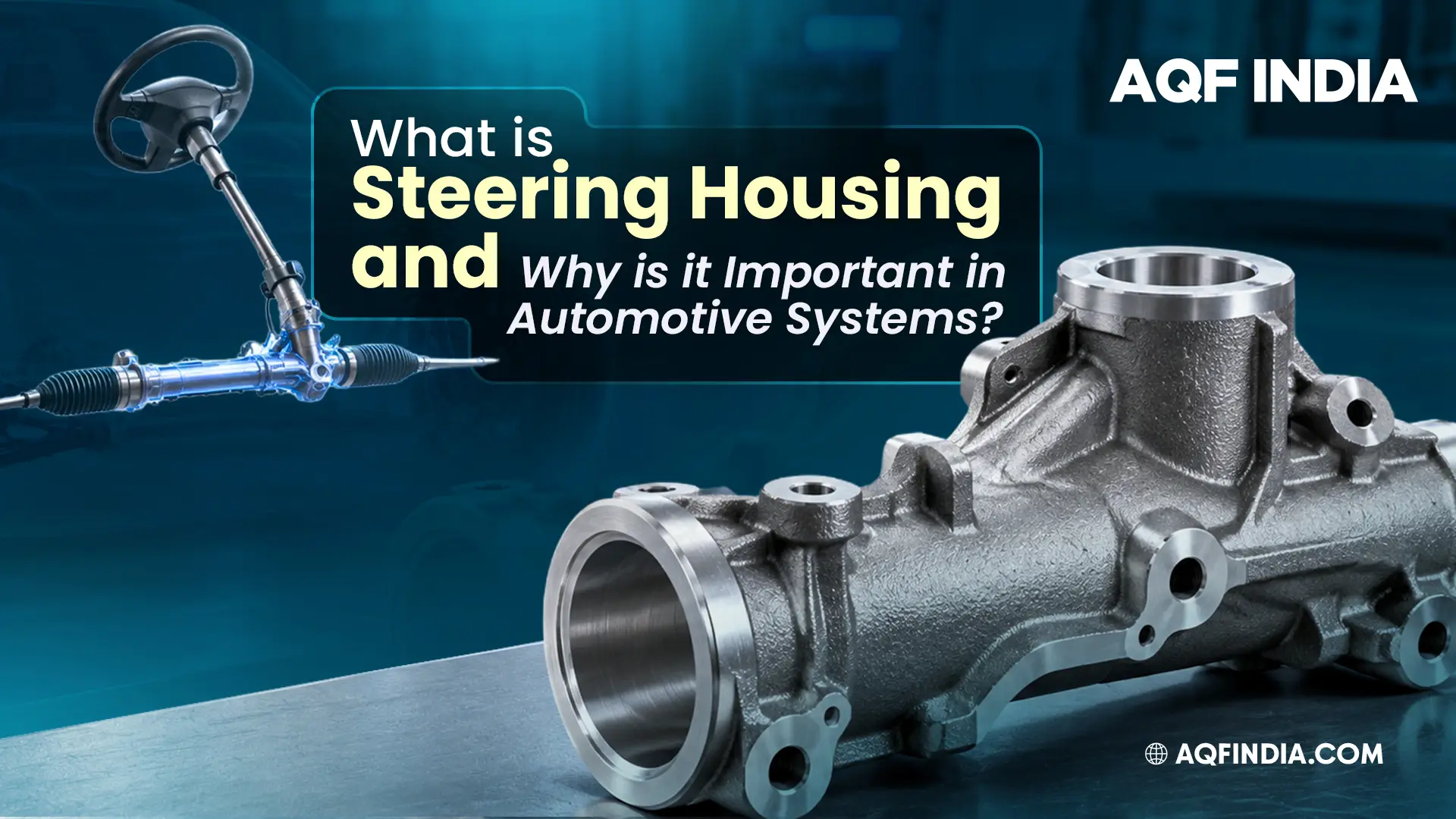
What Is Steering Housing?
Most modern cars steer with a rack-and-pinion. Turn the wheel and a small gear, the pinion, spins. Its teeth push a toothed bar, the rack, left or right. Tie rods at each end of the rack pull or push the front wheels. Simple idea.
The part holding all of this together is the housing, a long tube-like casting. The gears sit inside it. So do the seals. Mounting bolts go through it, and rubber boots at the ends keep the road muck out. On hydraulic units, there are fluid passages in there too. Trucks and tractors use a steering gearbox instead, which is bigger, but the housing’s job is the same.
Why It Matters More Than It Looks
Say a car has done 30,000 km and the steering feels a bit loose. The workshop swaps the rack. A few months on, the looseness is back. Odd, until somebody checks the housing and finds the rack bore was cut slightly out of line. The new rack never had a chance.
There’s no drama in this part. The wheel seems to be heavier on one side. There are knock-over speed breakers. A seal begins to weep. The driver says that something doesn’t feel right, and a mechanic loses a day looking for it.
Where It Fits Among Automotive Steering Components
Steering is a mechanism that has a chain of parts: wheel, column, shaft, rack and pinion, tie rods, and a knuckle at each wheel. The gear set is located in the middle of the housing. If it is not, then the error continues on after it.
We looked at the wheel end of that chain in Exploring the Steering Knuckle Machining Process. The same rule applies to both parts. Features have to agree with each other, not just hit a number on their own.
How Machining Fixes the Problem
A casting gives you a shape and not much else. Accuracy comes from the machine. Four features decide whether the housing works. The rack bore is long, and it has to be straight. The pinion bore needs the right angle and position relative to it. Seal seats need a fine finish, or fluid will find a way out. And the mounting faces must be flat; otherwise, tightening the bolts bends the housing.
So what helps? Cutting the connected bores in one setup, so they stay aligned. A 4th axis makes that easier because more faces get done without unclamping. Probe the bores inside the machine while the job runs, then confirm on a CMM.
Leaks are a separate headache. Castings can hide tiny pores, and machining opens them up. Check the blank before cutting and pressure test afterwards. We wrote about this for hot-side parts in Overcoming the Biggest Challenges in Turbo Housing Fabrication, and about bore alignment in What Does Bearing Housing Do?.
What to Ask Before You Pick a Supplier
Four simple questions go a long way. Are connected bores cut in one setup? Is the part measured during machining, or only at the end? Is the casting checked before cutting? Can they pressure test and show you batch records?
AQF India runs a foundry and a machine shop. Our machine shop handles SG and grey iron castings on Doosan and Makino machines, and checks happen in our in-house lab.
Final Thought
Nobody thinks about a steering housing until the steering starts to feel wrong, and by then the fix costs far more than machining it right would have.
Sourcing castings or machined parts for automotive steering components? Send us your drawing. We’ll say how we’d clamp, cut, and test it, and you take it from there. AQF India is a call away.
FAQs
1. What does a steering gear housing do?
It keeps the rack and the pinion in line, carries the seals and mounting points and holds dirt and moisture away from the gears.
2. Why is it that accuracy is important in this part?
The bores and seal seats determine the free movement of the rack and the retention of the fluid. Micro errors result in looseness, noise, uneven wear or leaks.
3. What materials would you use?
Cast iron is frequently employed when strength is important, such as in heavier vehicles. When weight is a critical factor, aluminium alloys come into play. This will vary according to the application.