

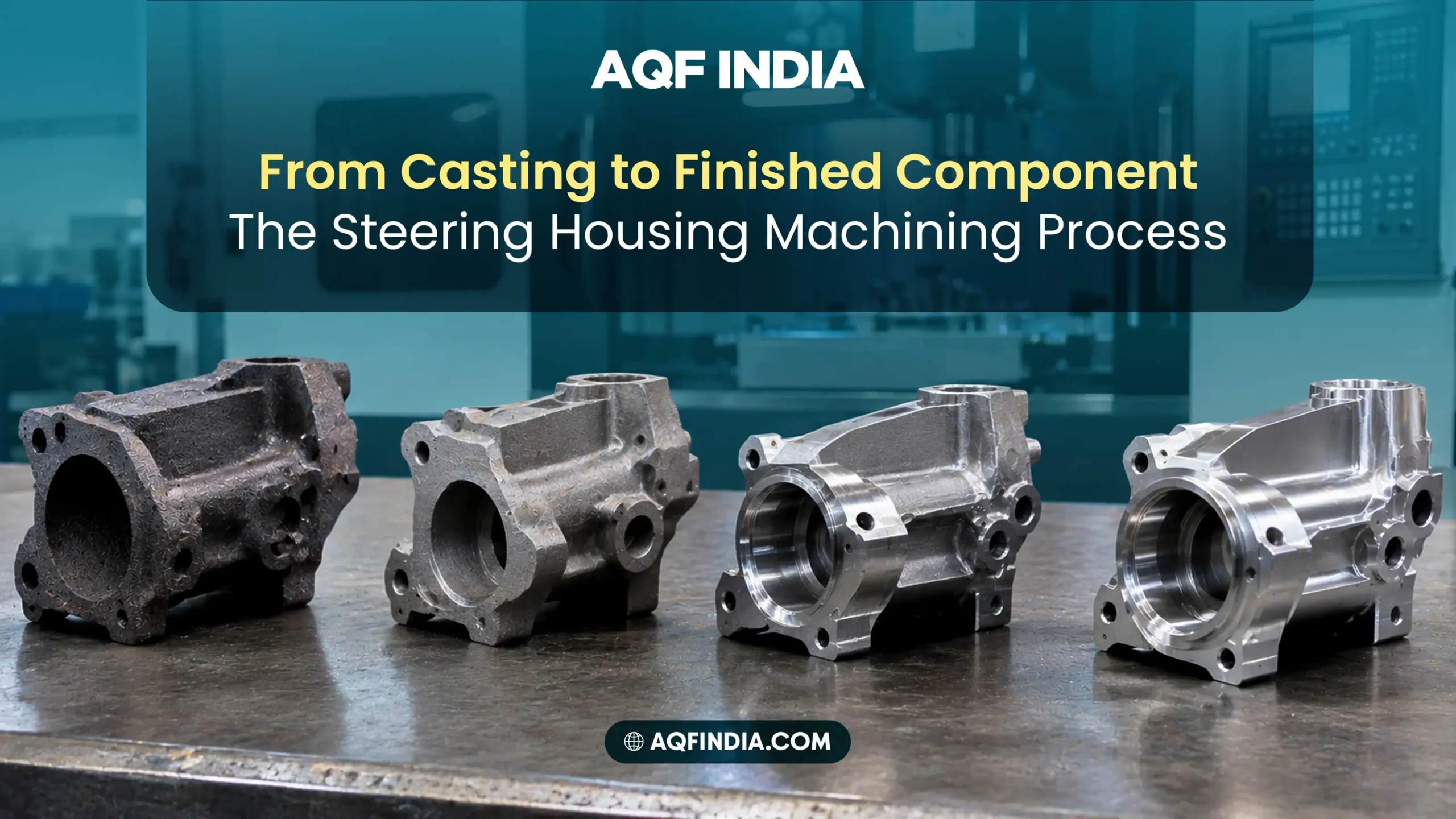
- Steering housing machining starts long before the first cut. It starts at the foundry.
- Good metal casting leaves less to fix.
- The steel casting process suits heavier-duty housings, and it changes how you cut them.
- Investment casting gets closer to the final shape, but bores and seal faces still need machining.
- Five stages carry a housing from raw casting to a part you can fit.
From Foundry to Machine Shop: Where It Starts
The steering housing doesn’t start on a CNC machine. It starts as molten metal being poured into a mould. The machine shop must cooperate with whatever the foundry sends. If an “extra stock” occurs in an unintended location, a “ hidden pore,” or a warped face, any subsequent step becomes more difficult.
It is for this reason that it is always best to plan metal casting and machining together. The foundry can leave the stock where you need it if you determine the machining first.
Choosing the Casting Route
The typical method of fabrication for iron housings is sand casting. A mould is formed in sand by pressing a pattern into it; the metal is poured into the mould and then broken out. Economical and suitable for medium to large parts.
Investment casting is a different animal. A wax copy of the part is coated in ceramic, the wax is melted out, and the metal goes into the empty shell. The result has a finer surface, thinner walls, and tighter dimensions, which means less stock to remove. The trade-off is cost and lead time, so it makes sense when the shape is complex, or the volume justifies it. Our own post on How Precision Casting Powers Automotive Performance goes into it further.
How the Steel Casting Process Changes the Machining Plan
Steel provides greater toughness and impact resistance than most cast irons, and is used for heavier loads. It also cools and shrinks more when it cools and also flows hotter than other metals, and often must be heat treated to obtain its final properties. When it arrives at the machine, it is more difficult to cut.
So the plan is modified. More challenging grades of tools, less cutting speed, more coolant, and more consideration of tool wear. A programme that works on grey iron will chew through tools on steel.
Steering Housing Machining, Step by Step
Details vary by design, but a good line usually follows this order.
First, the raw casting is checked. Machining can’t fix a bad blank, so dimensions, allowances and obvious defects are verified. Casting problems turn up here. If a core shifted while pouring, one wall ends up thinner than it should be, and a bore cut through it can break out the other side.
Next the part is clamped on stable locating surfaces, and the bulk of the material is taken off in a rough pass. Everything that follows is measured from those surfaces, so this step sets the tone.
Then come the bores. The rack bore has to be straight and true, and the pinion bore must sit at the right angle against it. Cutting related bores in a single setup keeps them aligned, and a 4th axis helps because more faces get done without unclamping.
After that, the finishing work: seal seats with a fine surface finish, mounting faces that are flat, threads and ports. Burrs where bores cross get removed carefully, because one loose burr can end up in the oil.
Last, the part is washed, pressure tested and measured on a CMM. Probes inside the machine have already checked the key features during the run, so the final check confirms the numbers and doesn’t uncover surprises.
Where Casting Defects Show Up
Porosity is the big one. Tiny pores stay hidden until machining opens the surface, and then a part that looks perfect starts to leak. Checking the casting first and pressure testing afterwards catches most of it. Our post on 10 Essential Principles to Minimize Casting Defects covers how to prevent these defects at the foundry itself.
What to Ask Before You Choose a Partner
Keep it practical. Who makes the casting decision and what do they look for prior to the casting going away? Do related bores follow in one set up? Does the part need to be measured during the machining process or at the end? Are they pressure testing and have batch records?
At AQF India, we run a foundry and a machine shop, which helps because casting and machining get planned together. Our foundry pours SG iron, grey iron, HiSiMo and ADI. The machine shop works on Doosan and Makino machines, and measuring happens in our in-house lab. If your design calls for a different route, talk to us early so the machining plan matches the casting.
Final Thoughts
Steering housing machining is easier when the casting is right, and the casting is easier to get right when someone has already thought about the machining. Treat metal casting and machining as one job, and most of the usual problems disappear before the part reaches the shop floor.
Got a housing drawing and a casting question? Send both over. We’ll go through the route, the clamping, and the checks with you. AQF India is a call away.
FAQs
Why is investment casting used for some housings?
The finer detail, thinner walls, and better surface make it possible to machine less material away from a casting when compared to sand casting. This is because it is more expensive and takes longer to use, resulting in it being used in a selective manner.
How does the steel casting process affect machining?
Steel is hard to cut and is typically heat-treated to make it tougher. Higher tool loads, slower speeds, and tighter tool wear monitoring will be required compared to grey iron.
Why is the casting inspected before machining?
The cost of detecting defects, such as porosity, shifted cores, and excess material, is significantly lower prior to the cutting process than when the part is already finished.