

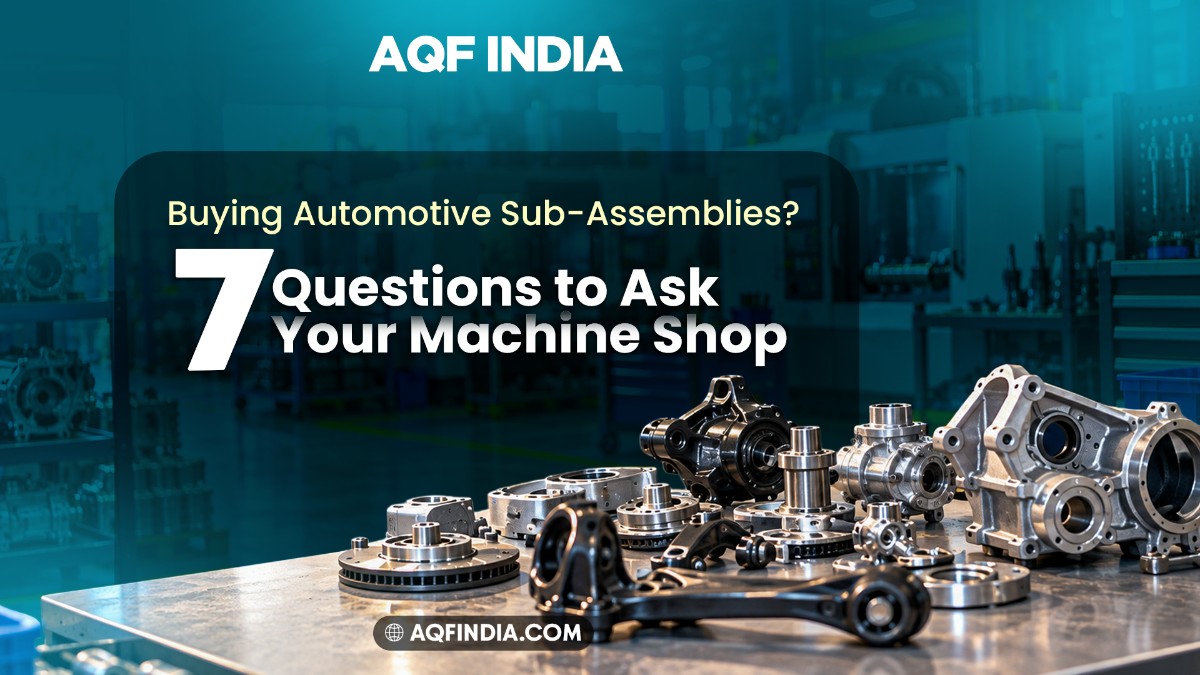
- Most sourcing mistakes with automotive sub-assemblies happen before the first part is ever cut at the vendor selection stage.
- A shop that machines individual parts well isn’t automatically equipped to deliver automotive precision components as a working assembly.
- The right questions upfront save months of rework, delays, and failed audits later.
- Not all CNC machine shops that advertise their services as “automotive” are capable of doing automotive work.
Why the Vendor Selection Stage Decides Everything
Most buyers evaluate a machine shop the same way they’d evaluate any supplier price, lead time, past clients. For simple, single-component orders, that’s usually enough.
Sub-assemblies are different. You’re not buying a part. You’re buying a system of parts that have to fit, function, and hold tolerance together. Get the vendor selection wrong here, and the mistake doesn’t show up in the quote, it shows up three months later, on your production line, as a batch that doesn’t fit.
Here are the seven questions worth asking before you commit.
1. Do You Machine Sub-Assemblies, or Just Individual Parts?
Some shops are excellent at cutting a single component to spec but have never taken responsibility for how that part performs once it’s mated to others. Ask directly whether they design tolerance stacks at the assembly level, or only per drawing. This one answer tells you more than anything else on this list.
2. What’s Your Multi-Axis CNC Capability?
Complex automotive precision components often need multiple operations in a single setup to hold tight tolerances. A shop still relying heavily on manual repositioning between operations will struggle to hold consistency across a batch, and consistency is the whole point of a sub-assembly.
3. How Do You Catch Problems Before Final Inspection?
Any shop can show you a final inspection report. Fewer can explain what happens during machining in-process checkpoints that catch drift before it spreads across an entire batch. If their answer is “we check everything at the end,” that’s a red flag for sub-assembly work specifically.
4.Can You Show Traceability Per Batch?
If a defect shows up in the field six months from now, can this CNC machine shop trace it back to the exact material lot, machine, and operator? Automotive parts suppliers who can’t answer this clearly aren’t set up for the kind of accountability OEM programs require.
5. How Do You Handle Fitment and Functional Testing?
Just because parts are dimensionally correct doesn’t mean they fit together. Before dispatch, not only measured against a drawing but also test fitted and functionally checked torque, rotation, sealing etc. before components are sent.
6. What Happens When a Design Needs to Change Mid-Project?
Automotive programs shift. A shop that treats every design change as a fresh negotiation will slow your program down. Look for one that’s built for design-stage collaboration, not just order fulfilment.
7. What’s Your Actual Automotive Experience, Not Just General Machining?
“We do automotive” and “we’ve supplied automotive precision components to OEM programs for years” are two very different claims. Ask for specifics: which components, at what tolerance, at what volume. Vague answers here usually mean vague quality later.
Quick Reference: What Good Answers Sound Like
| Question Area | Weak Answer | Strong Answer |
| Assembly-level thinking | We machine to your drawing. | We design tolerance stacks across the full assembly. |
| Machining capability | We can get it done. | Multi-axis setups minimize repositioning error. |
| Quality checks | We inspect at the end. | We monitor in-process, batch by batch. |
| Traceability | We keep basic records. | Every batch is traceable to the machine and operator. |
| Automotive experience | We’ve done automotive work before. | Specific components, tolerances, and volumes named. |
ALSO CHECK – Flexible CNC Machining Solutions in Coimbatore: Why AQF India is Preferred Choice
Final Thought
Sourcing automotive sub assemblies isn’t just a purchasing decision, it’s a quality decision made months before the first part reaches your line. Ask these seven questions, and you’ll quickly separate machine shops that can cut a good part from those built to deliver a working assembly.
At AQF India, we’re built around exactly this distinction. As a CNC machine shop working with automotive parts suppliers and OEMs across drivetrain, hydraulics, and precision assemblies, we design, machine, and test at the assembly level not just the part level. If you’re evaluating vendors for your next sub-assembly program, these are the answers we’d be glad to walk you through directly.
Frequently Asked Questions (FAQs)
- Why is sourcing automotive sub assemblies different from sourcing individual parts?
Because sub-assemblies depend on how multiple parts fit and function together, not just how accurately each one is machined on its own. - What’s the biggest red flag when evaluating a CNC machine shop for sub-assembly work?
Relying only on final inspection instead of catching issues during machining, and being vague about actual automotive experience and volumes handled. - How can automotive parts suppliers prove they’re ready for OEM-grade sub-assembly work?
Through documented traceability, in-process quality checks, and the ability to show specific automotive precision components they’ve delivered not general machining claims.