

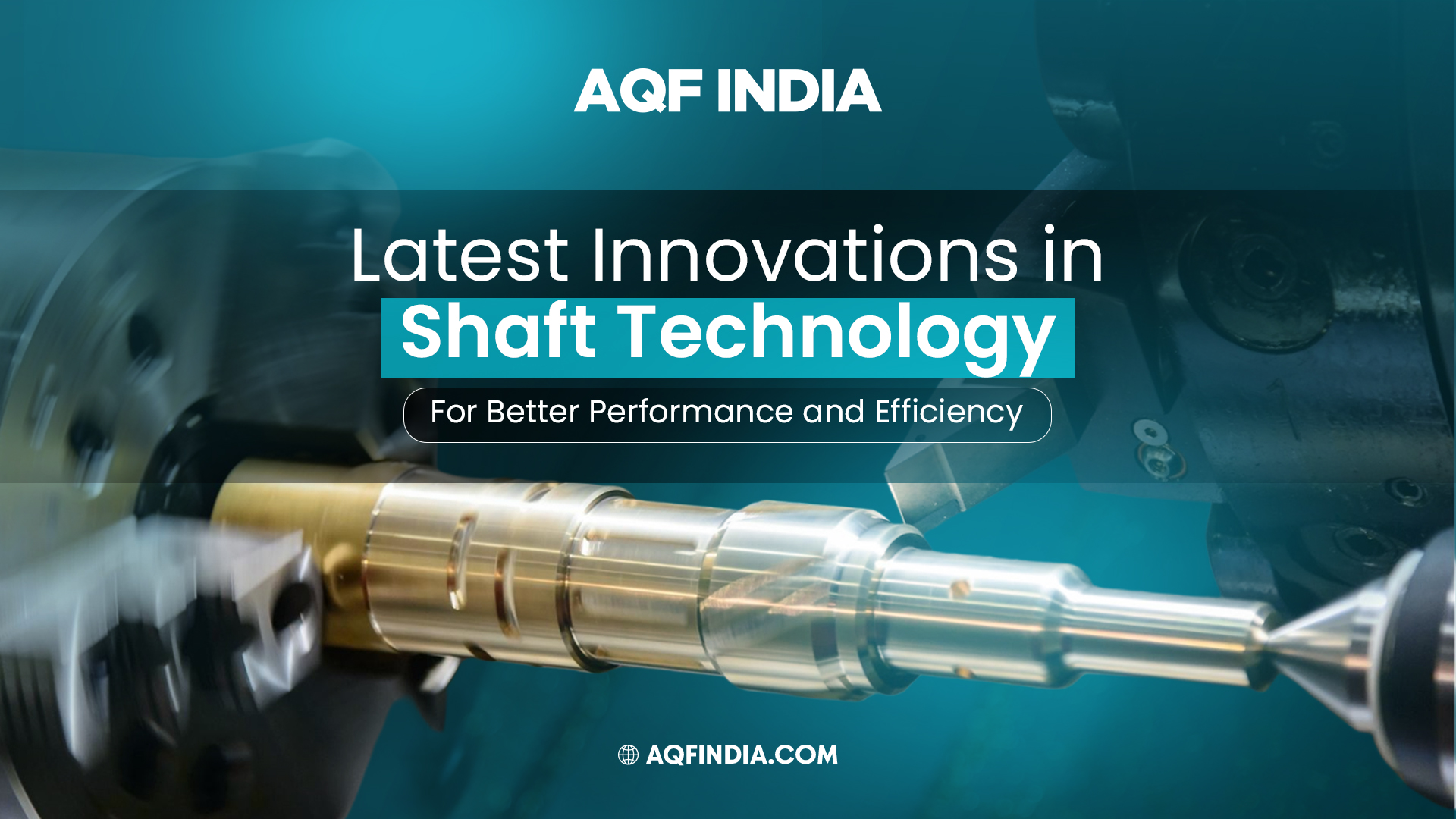
- Advanced shaft design now incorporates near-zero tolerance mapping with the help of AI.
- Solid shafts are being replaced in industrial manufacturing by hollow, light-weight, high-strength shafts.
- In heavy-duty cycles, surface hardening breakthrough improves the mechanical life of shafts by up to 40%.
- Unplanned downtime is eliminated with the use of smart embedded sensors that monitor shaft health in real time.
Precision Redefined: AI Meets the Lathe
There is a quiet revolution in the design and validation of shafts! Now, machine learning models predict dimensional drift before a single chip is cut, and our engineers receive real-time corrective feedback during the CNC cycle. Where three rounds of inspection were once mandatory, we now compress the entire process into a single round. Tolerances previously held at ±0.02 mm are now consistently within ±0.005 mm, and simply cannot be replicated downstream through a retrofit.
We don’t just machine shafts; we engineer the predictability that every connected component downstream depends on.
Hollow Shafts: Less Weight, More Work
The transition from a solid to a hollow shaft mechanical architecture is not a compromise, but a structural leap. We use finite element analysis (FEA) to engineer exact wall-thickness ratios, and we reduce rotating mass by 25–35% to match or surpass conventional solid-bar designs, with torsional rigidity. For agriculture, off-highway and hydraulic systems, mass saving equate directly to fuel savings, longer bearing life, and smoother power transmission at higher RPMs. It’s not just lighter, it’s smarter.
Surface Hardening: The Story of Microns and Millions
Case hardening, induction hardening, and laser surface treatment have all developed very rapidly. Now we have induction hardening cells which highlight specific shaft areas, journals, splines, keyways, etc., without damaging the core ductility of the shaft. It achieves 58-62 HRC on critical contact surfaces and 28-32 HRC on the core of the shaft for impact resistance. In cyclic-load applications, that’s the difference between a 10,000-hour shaft and a 6,000-hour shaft.
Each hardened zone is verified by metallographic cross-sections, and not taken for granted based on process parameters.
Smart Shafts: Sensing What the Eye Can’t See
At the design level, changes are actively made to shaft assemblies to embed micro-sensors, strain gauges, thermocouple films, and MEMS accelerometers. These components are able to send real-time torque, temperature, and vibration data to condition-monitoring platforms, providing plant operators with an instant health index of each shaft in the drivetrain. This transition from calendar-based maintenance to condition-based maintenance is estimated to reduce unplanned downtime between 30% and 50% per year for the entire industrial manufacturing industry for high-utilisation facilities. We are actively integrating this capability into our shafts, as precision without insight is half the job.
Sustainable Alloys: Performance With a Conscience
AQF India has taken a decisive step towards low-carbon alloy inputs, which are sourced from mills with carbon-intensity certified materials, namely SAE 4140 and EN36, EN353. In addition to sourcing, we have restructured our heat treatment schedule so that similar alloy grades are grouped to reduce energy usage in our furnaces by nearly 18% in the last cycle. There’s no conflict between precision and sustainability. If planned correctly, leaner processes result in tighter outcomes as the controlled thermal cycles result in more uniform microstructures than the overloaded ones.
Ready to upgrade your shaft mechanical performance?
With a production facility in Coimbatore spread across 1.5 lakh sq ft and ISO 9001:2015 quality systems, AQF India has a precision manufacturing expertise of over 50 years for every part we machine, irrespective of whether it is an engineering high-torque drivetrain or a critical shaft assembly.