

- Precision machined parts eliminate fitment errors at source.
- They keep automotive assembly line cycle times consistent.
- Tight tolerances mean zero rework on critical joints.
- Reliable machining parts reduce line stoppages significantly.
- Every automotive component manufacturer depends on dimensional accuracy.
Why the Assembly Line Cannot Forgive Even 0.01mm
Modern automotive assembly lines move fast, sometimes a new vehicle every 60 seconds. At that speed, a component that is even marginally off-spec does not just slow things down. It fails, and it fails visibly. Brakes that drag. Transmission housings that vibrate. Steering columns that don’t align.
This is exactly where precision machined parts carry their weight. When a component is machined to exact tolerances, it drops into the assembly station without correction, without shimming, and without delay. That repeatability is not a luxury on the assembly floor; it is the baseline expectation.
What we supply as an automotive component manufacturer has to meet that expectation every single batch, not just every once in a while.
What Goes Wrong Without Precision: A Quick Comparison
| Assembly Challenge | Without Precision Machining | With Precision Machining |
| Fitment at station | Needs manual adjustment | Direct drop-in assembly |
| Cycle time variance | Highly inconsistent parts | Stable uniform dimensions |
| Rework rate | 3–8% of output | Below 0.5% |
| Line stoppage risk | Frequent | Rare |
| End-product reliability | Variable | Consistent |
What Machining Parts Actually Do Inside the Assembly Line
Machining parts serve roles far more specific than “metal components.” Here is where they show up and why their accuracy matters most.
Engine and Powertrain Stations
Parts such as cylinder blocks, crankshaft housings, and bearing caps require super-precision finishing in the order of microns. Even the slightest deviation in this area will significantly affect engine oil film distribution, heat dissipation, and ultimately engine wear over time.
Brake and Steering Modules
Making brake caliper brackets and knuckle arms that do not misinterpret the suspension geometry is an engineering masterpiece. The caliper has to stay parallel to the rotor, which is a result of the suspension geometry, as the only point of contact between the tire and the road. A misalignment in a caliper is not just a small defect; it is a complete safety failure.
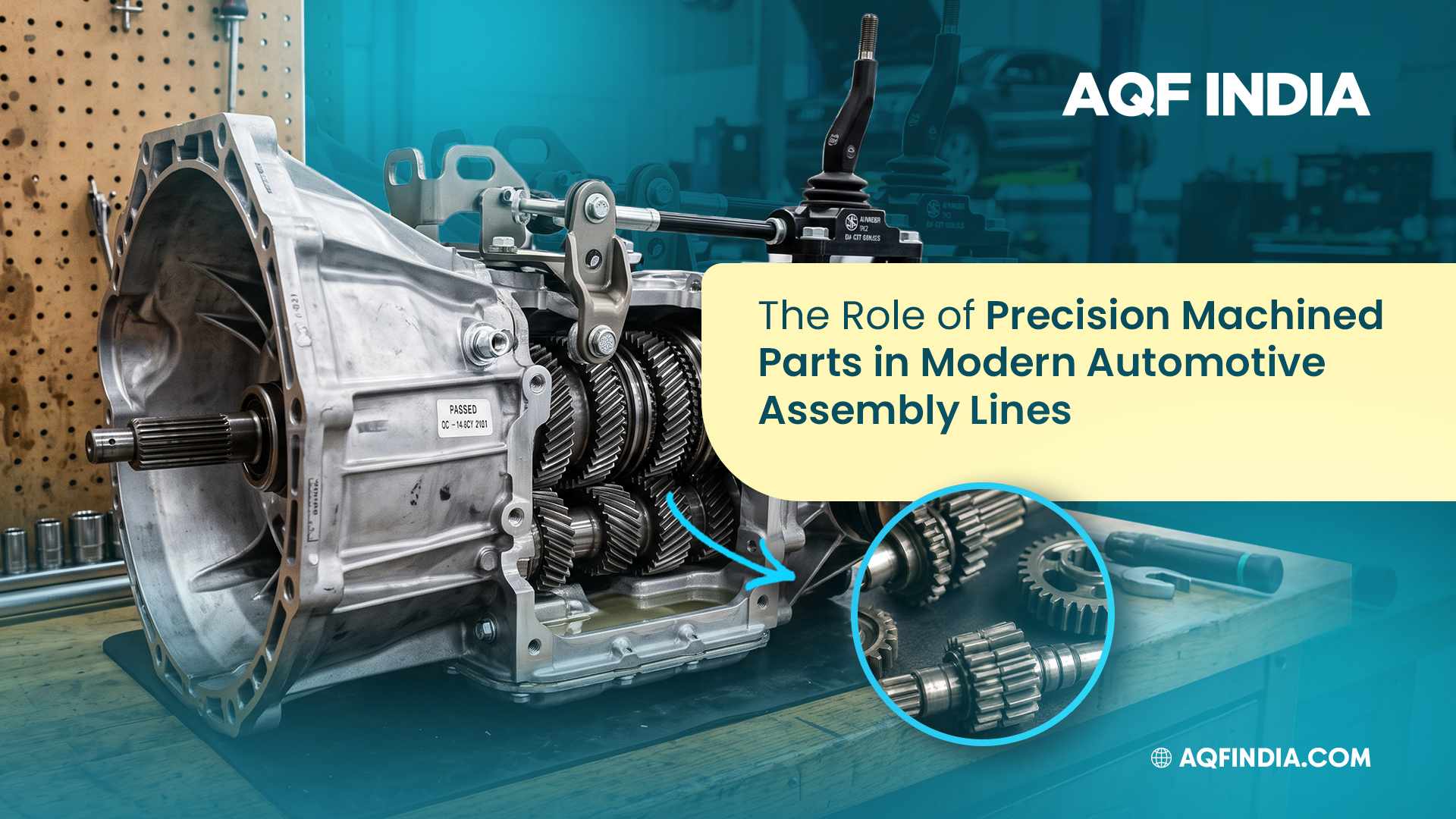
Transmission and Gearbox Assemblies
Gear housings, selector forks, and synchronous hubs need high precision, perfect bore holes, and exact parallels. Noise, vibrations, and harshness (NVH) issues are a very common reason for discomfort in the finished car; the problems usually arise from machining at this stage being of bad quality.
Body and Chassis Mounting Points
Mounting points in the form of brackets and flanges fix the body to the frame. Any slightest deviation from the drawings in the position of these features may give rise to panel gaps later.
The Three Standards Every Automotive Component Manufacturer Must Hit
| Standard | What It Means | Why It Cannot Be Skipped |
| Dimensional Consistency Across Batches | Every unit in an order must match the same drawing spec. | OEMs source thousands of units; the 5,000th part must be identical to the first. |
| Surface Integrity, Not Just Finish | Machining must protect the health of subsurface material, not just achieve a smooth exterior. | Heat, load, and vibration in automotive assemblies expose subsurface stress, leading to early fatigue failure in the field. |
| Documentation Traceability | Every machined part must carry full process data linked to its batch. | Assembly lines operate under tight QC frameworks; cutting parameters, inspection results, and batch identity must all be traceable. |
Where Precision Machined Parts Create the Biggest Impact
| Component Type | Tolerance Range | Assembly Impact |
| Engine bearing housings | ±0.005 mm | Oil pressure and wear life |
| Brake caliper brackets | ±0.01 mm | Braking performance and safety |
| Transmission gear housings | ±0.008 mm | NVH levels and gear shift quality |
| Suspension knuckles | ±0.02 mm | Wheel alignment and handling |
| Chassis mounting flanges | ±0.05 mm | Body rigidity and panel fit |
What Leaner Assembly Lines Demand From Suppliers
Automotive OEMs are running leaner than ever, with smaller buffer stocks, faster changeovers, and tighter delivery windows. That pressure lands directly on the quality of machining parts arriving at the dock.
When precision machined parts arrive inspection-ready, they skip incoming QC and move straight to the line. No hesitation. No delay. That is exactly what lean production depends on.
We work closely with OEM and Tier-1 suppliers who live inside this pressure daily. What we supply is built to perform at the line, not just pass a report.
Final Thought
The automotive assembly line leaves no room for error. Every component must perform on spec, every shift, every batch.
Precision machined parts are not just inputs; they are what keep the line moving. If you need an automotive component manufacturer who matches your drawings, volumes, and delivery windows, reach out to AQF India.
FAQs
- How accurate do precision machine parts have to be for automotive applications?
- About ±0.005 mm to ±0.05 mm, depending on the part. In general, tighter for engine and brake parts and much more relaxed or even broad for frame mount parts.
- How does an automotive assembly line benefit from inspection-ready parts?
- Parts that arrive pre-verified skip incoming QC entirely, reducing line wait time and keeping production on schedule.
- What makes a reliable automotive component manufacturer for OEM supply?
- Batch-to-batch dimensional consistency, surface integrity, and full documentation traceability- all three, without compromise.