

- A steering gear housing looks simple on the drawing and gives trouble on the shop floor.
- A steering rack housing carries long bores that must stay straight, round, and sealed.
- Porosity, burrs, and bore alignment cause most of the scrap.
- Manufacturers of automotive components that plan early lose less time reworking.
- Precision manufacturing systems work when machining, probing, and leak testing run as one flow.
Why a Steering Gear Housing Is Harder to Make Than It Looks
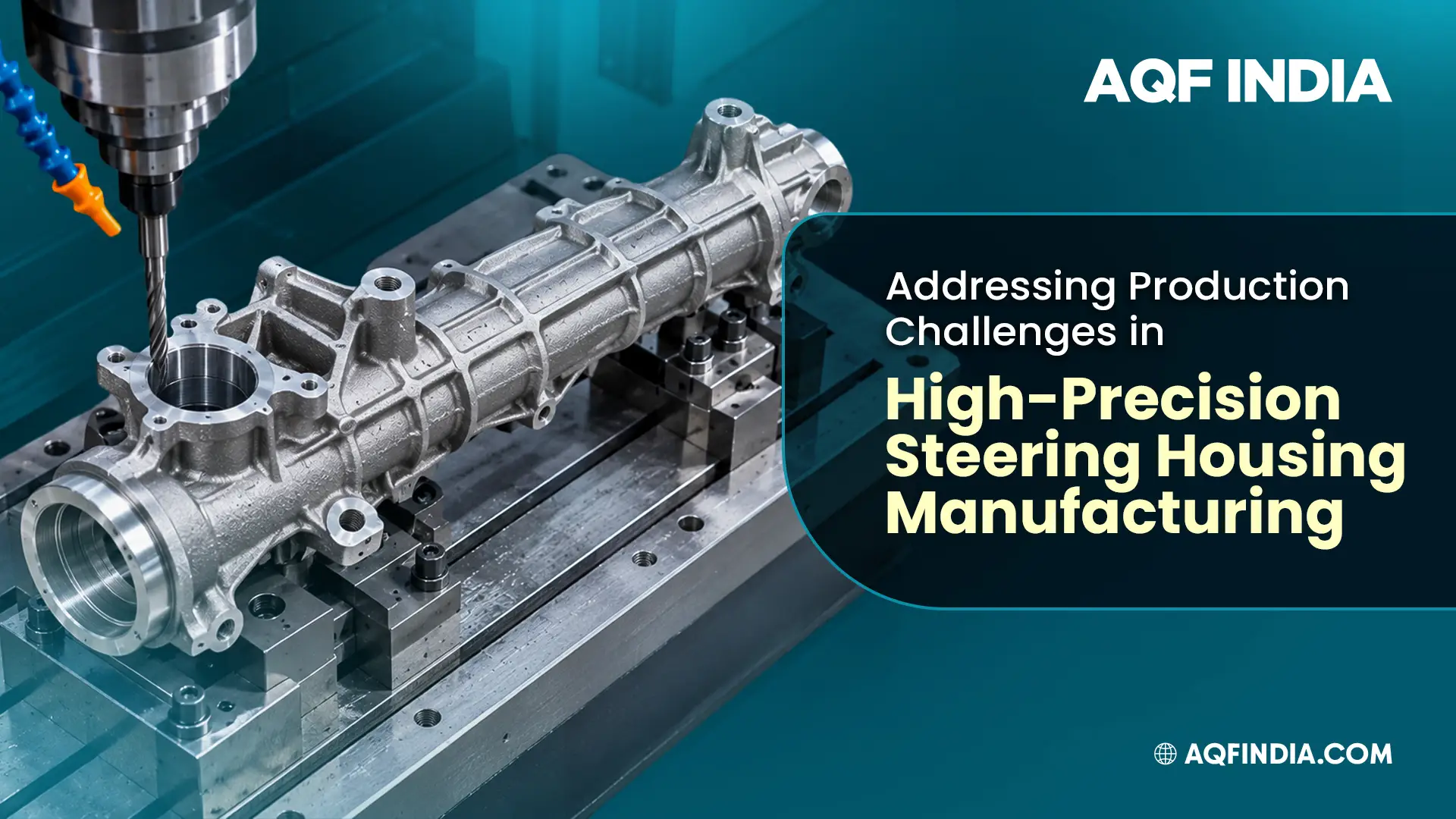
It’s a small casting, the kind you can hold in two hands. Open the drawing, though, and the list is long. Deep bores, seal seats, mounting faces, threaded ports. In hydraulic versions, there are oil passages that cross each other inside the metal.
Tolerances on these features aren’t forgiving. A bore that’s a little off doesn’t fail on day one. It shows up later as loose steering, a knock over bumps, or a seal that weeps. So most of the work is stopping small errors before they leave the plant.
Here are the four places where production usually gets into trouble, and what helps at each.
Challenge 1: The Long Bore in a Steering Rack Housing
The rack runs down one of the long bores. That hole must be straight, round, and smooth enough for the seals to fit. The longer the bore, the more difficult it is! As the tools pass deep, they are slightly bent, and the bore may end up being a little tapered or off-centre.
The good news is that the bores of these are cut in one operation and remain aligned. Followed by the stiff tooling and sensible cutting depths. The diameter and surface finish of the seal are usually set by a final finishing operation, such as honing. Next, check the bore within the machine and verify it on a CMM prior to it going on to the next part.
Challenge 2: Porosity You Can’t See
Very small pores can be masked by castings. The surface gets cut, and one of those pores is a leak path. A part that was perfect on the bench begins to leak oil under pressure.
Most of it is covered by two checks. View the casting prior to being machined, to ensure the poor blanks don’t end up in the machine. Then submit to a pressure test of the completed part. Leak-test experts say that it’s a good idea to do a leak test before and after the part is cut because it is better to identify a bad part early on in the process rather than later. We test for air, water, and oil; it gets a leak before we do.
Challenge 3: Burrs at Intersecting Bores
Wherever two bores meet inside the housing, a burr forms. Small, sharp, and easy to miss. If it breaks loose later, it travels with the fluid and can jam a valve or scratch a seal.
The solution is not spectacular, but it does serve its purpose. Minimize the amount of burr created in planing, deliberately deburr cross-holes, wash and inspect bores for loose particles. If any of those are left out, the problem rears its ugly head out in the field.
Challenge 4: Keeping the Batch Steady
The first ten parts are usually fine. Around the fiftieth, tools wear, and the machine warms up, and the numbers start to drift. Nobody notices until the gauge does.
So the plan has to include tool life counting, in-machine probing, and regular CMM sampling. Drift gets caught in minutes instead of after a full tray of parts.
Putting Precision Manufacturing Systems to Work
Each fix above helps by itself. The real gain comes when they run as one chain: casting check, machining, deburring and washing, in-machine probing, leak test, final measurement. When precision manufacturing systems are set up this way, a problem gets caught at the step where it begins, not three steps later.
That’s the idea behind a few of our earlier posts too, such as Why Precision Engineering is Critical for Automotive Production Lines and 5 Common Quality Issues in Automotive Line Production and Their Solutions.
What to Ask Before You Pick a Supplier
Keep the questions plain. Are related bores cut in one setup? Do they probe during machining or measure only at the end? Is the casting checked first? Can they pressure test and show batch records? Good automotive parts manufacturers answer these without hesitation.
At AQF India, we run a foundry and a machine shop. The machine shop works on Doosan and Makino machines with multi-axis capability up to the 4th axis, and measuring happens in our in-house lab. The same bore and leak-testing thinking appears in our posts on the steering knuckle and the turbo housing.
Final Thoughts
Nothing about a steering gear housing manufacturing is mysterious. Long bores, hidden pores, burrs, and drift are well known, and every one has a practical fix. What matters is planning for them before the first cut and not after the first complaint.
If you’re sourcing housings for automotive parts manufacturers or for your own line, send us the drawing. We’ll tell you how we’d clamp it, cut it, and test it. AQF India is a call away.
FAQs
What are the biggest challenges in making a steering rack housing?
Keeping the long bore straight and round, avoiding hidden porosity, removing burrs where bores cross, and holding the same accuracy across a full batch.
How do you check a housing for leaks?
The finished part is pressure tested, typically with air, water, or oil, and the casting is checked before machining so poor blanks are removed early.
Why do manufacturers talk about process flow and not single machines?
Because most defects start at one step and show up at another. When the steps are linked, problems are caught where they begin.